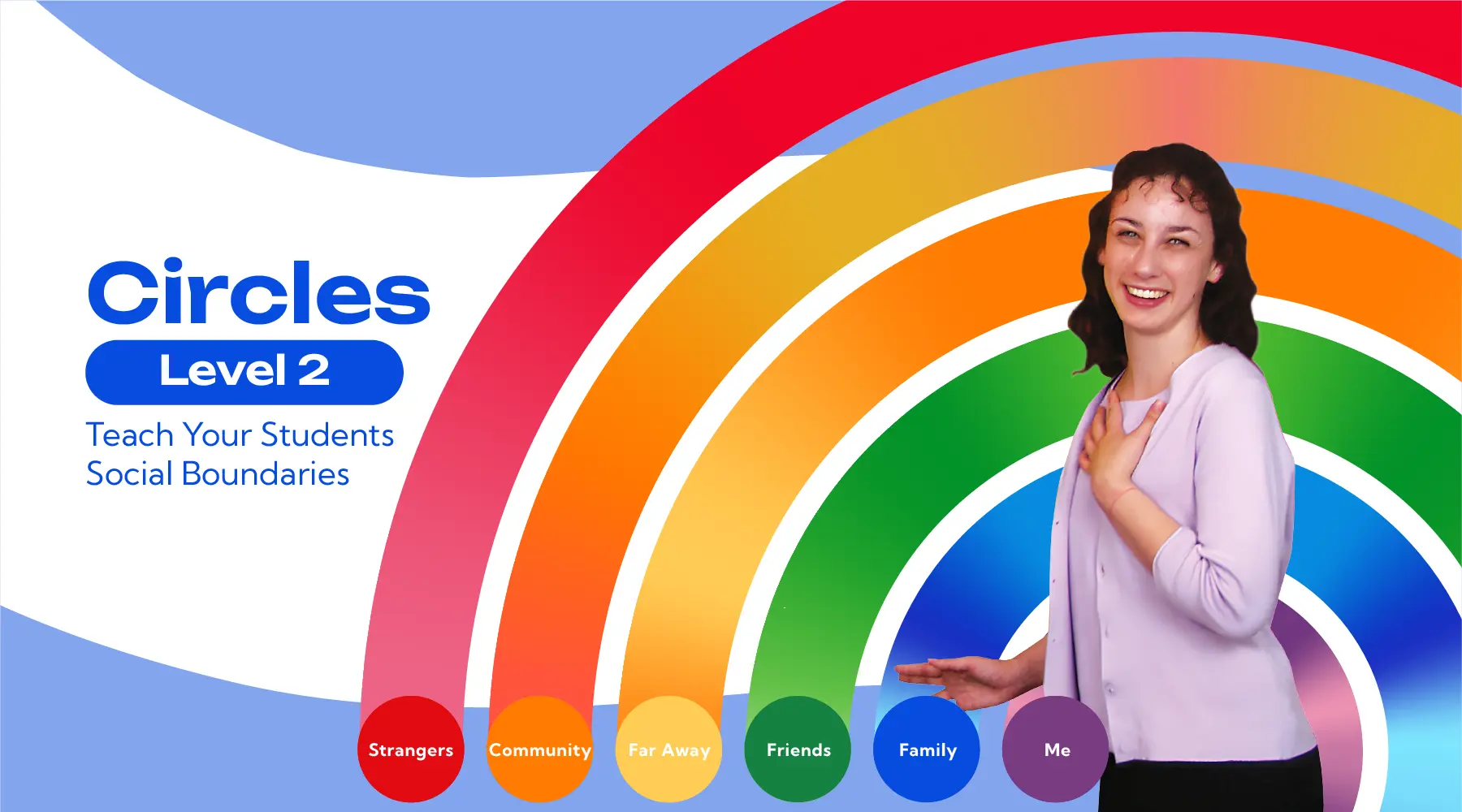
Circles Level 2
Romantic relationships can be tough for teens to navigate - this bundle will help you teach intimate boundaries with ease.
What It's About
Once students master the fundamentals of social boundaries, they are ready for the next challenge. The Circles Level 2 program picks up exactly where Level 1 leaves off — moving beyond basic personal space and boundary concepts into the more complex, nuanced realities of relationships that students ages 12 and up will encounter as they grow toward independence.
Created by Marklyn P. Champagne and Leslie Walker-Hirsch, Level 2 is built on the same Harvard-validated Circles paradigm that has been trusted in classrooms for over 40 years. It uses video modeling with real-life scenarios to help students navigate topics that many curricula avoid: dating, healthy romantic relationships, changing friendships, and the emotional challenges of growing up.
Why does Level 2 matter? Because relationships do not stay static. Friends drift apart. Romantic interests develop. People change. Students need concrete strategies for handling these transitions — not just understanding boundaries in theory, but applying them when relationships shift in unexpected ways.
The program includes live-action vignettes, a comprehensive digital teacher's guide, and printable handouts — everything you need to implement lessons with confidence. Circles Level 2 is available through a Circles subscription (99/yr) or as part of Stanfield+ (99/yr), which provides access to our full program library. If your students have completed Level 1, Level 2 is the essential next step in their social education journey.
This curriculum is presented in a relaxed, child-friendly format that makes it accessible for even the youngest students.
What You'll Learn
The Circles Level 2 program is an excellent follow-up for students who have already completed the Circles Social Boundaries: Intimacy & Relationships program. It takes a more comprehensive approach to understanding the subtler applications of the Circles Rules of Social Distance, making it especially effective for students with moderate to mild cognitive challenges.
Circle Jumping
Circle Jumping refers to the process of moving from one Circle level to another. In Level 2, there is a more in-depth illustration of when it is acceptable to jump circles and when it is not. Students learn the importance of proximity, context, and the nature of the relationship before deciding to move to a higher or lower circle. Through video-modeled examples, they see these concepts play out in realistic situations.
Reversal of Intimacy Level
The program covers the concept of Reversal of Intimacy Level — situations where students who are accustomed to being in an inner circle face a sudden change when they are shifted into an outer circle. It helps students understand the realities of change and how to navigate such situations while keeping social boundaries in check.
Rejecting Intimacy and Having Intimacy Rejected
Rejection is one of the hardest social experiences for any person, and it is especially challenging for students with disabilities. Level 2 teaches students how to manage relationships with people who have changed circles — while still maintaining their own comfort and boundaries. The program provides strategies for communicating boundaries without offending friends or family.
Relationship Dissolution
Students learn how to recognize cues that indicate a relationship is ending, how to cope in such situations, and how to move on by re-establishing social connections. This is a critical life skill that prepares students for the inevitable changes they will face in adolescence and adulthood.
Part I: Social Distance — Expanded
The Circles concept introduced in Level 1 is expanded in Level 2. The subtler concept of degrees of intimacy within the same circle is introduced, allowing for more variation in similar relationships. Touch, talk, and trust are the three social boundaries evaluated and applied to each relationship. Students learn that boundaries may vary in different situations and with different people — a nuanced understanding backed by over 40 years of evidence-based classroom practice.
Part II: Relationship Transitions
This section uses live-action reality stories to review the dynamic and ever-changing nature of relationships. It introduces the new and subtle signals expressed by touch, talk, and trust that indicate a change in a relationship — changes that may or may not be mutual.
Your students will learn how to recognize these signals, which indicate circle jumping, reversal of intimacy levels, and rejection of intimacy or relationship dissolution. They will also learn strategies for dealing with these changes to maintain healthy relationships and protect themselves emotionally.
Students will feel empowered as they put these concepts into practice and start seeing positive results in their relationships.
In Conclusion
After completing Circles Level 2, your students will have the skills to set and maintain healthy boundaries in their relationships — a crucial ability that will serve them well throughout their lives. They will understand the nuances of social intimacy and how it varies from person to person, helping them recognize potential red flags and make informed choices.
Students who complete Level 2 consistently demonstrate greater emotional resilience when relationships change. They can handle rejection with composure, recognize when a friendship or relationship is dissolving, and take proactive steps to rebuild their social connections. These are not abstract concepts — they are practical, real-world skills developed through the same video-modeling approach validated by Harvard research.
The combination of Levels 1 and 2 gives students a comprehensive social education — from basic boundary awareness to the complex dynamics of changing relationships. Educators report that students who complete both levels show marked improvement in peer interactions, self-advocacy, and emotional regulation.
As educators, it is our responsibility to equip our students with the knowledge and skills they need to make informed choices about their lives. Circles Level 2, built on 40 years of proven classroom results, is one of the most effective tools available. Whether accessed through a Circles subscription (99/yr) or Stanfield+ (99/yr), this program is an investment in your students' long-term social success.
The skills learned are designed to be lifelong assets, aiding students in feeling secure and connected throughout their educational journey and beyond.
What's Inside
15+ Hours of Instruction
2 units| Part 1 — 12 activities | |
| 1 |
Me
In this story, we are introduced to Faith, the main character and the role model for all of the stories in this program. She is confused by the many p...
|
| 2 |
Family
In this story, Faith is shown with her nuclear family. They discuss Faith staying out too late and not being responsible enough. Even though Faith and...
|
| 3 |
Sweetheart
In this story, Faith tells about her boyfriend Scott and the social activities they mutually enjoy: hiking, talking by the lake, playing frisbee, and...
|
| 4 |
Relatives
Faith visits her father at the hospital with her family in this story. Her extended family is also visiting. Faith greets her aunt, uncle, and cousin...
|
| 5 |
Friends
In this story, Faith introduces us to her close friends: Sarah, Emily, Jeanne, and
Kendra. Faith tells us that these are friends she knows from school...
|
| 6 |
Acquaintances - At Work
In this story, Faith meets her job coach, Ms. Hamilton, and her prospective employer, Mr. Calderone, at a job interview. Mr. Calderone asks Faith many...
|
| 7 |
Acquaintances - Neighbors
In this story, Faith introduces us to her neighbor, Ms. Rossi, who is visiting Faith’s mother. They exchange polite small talk about the neighborhood,...
|
| 8 |
Children
In this story, Faith tells us about two children living in her apartment building. She has seen them playing in the area and heard their names, but sh...
|
| 9 |
Strangers - Service Providers/Community Helpers
In this story, Faith tells us about some of the service providers she encounters. She identifies them as strangers since she does not know anything ab...
|
| 10 |
Strangers - Health Workers
In this story, Faith tells us about her experiences with health workers. She identifies them as strangers since she does not know anything about them,...
|
| 11 |
Total Strangers
In this story Faith tells us her experiences with other strangers. Faith defines a stranger as a person who you do not know even if you know about tha...
|
| 12 |
Review
Review everything you have learned.
|
| Part 2 — 8 activities | |
| 1 |
Always Strangers
In this story, Faith introduces the concept of developing relationships that may transition from one circle into an adjacent circle and then perhaps a...
|
| 2 |
Kids on the Block
In this story Faith sees two neighborhood children, Alex and Corey, from her apartment building. These boys are playing Frisbee in the courtyard of th...
|
| 3 |
On the Job
In this story, Faith goes to her job on the first day. She is escorted by her work-training teacher, who is well-trusted and introduces Faith to her n...
|
| 4 |
Uninvited Circle Jumpers
In this story, Faith tells us about a co-worker named Laser. When Laser wants to shake hands with Faith, she is comfortable with the idea of a Yellow...
|
| 5 |
Becoming Friends
In this story, Faith tells us about how her very close friendship with Sarah develops at school and after school. One day, when Faith is at school, sh...
|
| 6 |
Becoming Sweethearts
In this story, Faith tells us how Scott became closer to her and eventually earned a place in the sweetheart spot in Faith's Blue Hug Circle. Faith an...
|
| 7 |
Jumping Backwards
In this story, Faith provides an alternate scenario for her relationship trajectory with Scott. She imagines that the relationship does not continue t...
|
| 8 |
Review
Review everything you have learned.
|
Frequently Asked Questions
What age group is Circles Level 2 designed for?
Circles Level 2 is designed for students ages 13+, including those with intellectual disabilities, autism spectrum disorder, learning disabilities, and emotional/behavioral needs. The content uses video modeling with real-life scenarios that work across ability levels.
What materials are included with Circles Level 2?
The program includes 21 lessons with approximately 2 Hrs of video content. Each lesson includes streaming video content, a comprehensive digital teacher's guide with step-by-step instructions, printable student worksheets, discussion activities, and assessment tools. All materials are accessible from any browser.
Is Circles Level 2 included in a Stanfield subscription?
Yes. Circles Level 2 is included in the Circles plan ($499/year for all 4 Circles programs) and in Stanfield+ ($999/year for the full library of 60+ programs). Both plans include a 30-day free trial with no credit card required.
What standards does Circles Level 2 align to?
Circles Level 2 aligns to CASEL Social-Emotional Learning standards, ASCA Mindsets & Behaviors, and IEP Goal Domains. Standards alignment documentation is available for every lesson to support compliance and IEP planning.
Can I use Circles Level 2 on a smartboard or projector?
Yes. All Stanfield programs stream from any browser — smartboards, projectors, Chromebooks, tablets, or any internet-connected device. The entire library is also closed-captioned for accessibility.
Is Circles Level 2 appropriate for students with autism?
Yes. Circles Level 2 was specifically designed for students with intellectual disabilities, autism spectrum disorder, and related needs. The concentric circles model provides a concrete, visual framework that students on the spectrum can understand and apply to real social situations.